One of the most common questions parents in Tamil Nadu face before school admission is straightforward: CBSE or Matriculation?
Both are legitimate boards with established schools across the state. But they are built differently, they prepare students differently, and they lead to different outcomes depending on what your child wants to do after Class 12.
This guide breaks down the real differences across curriculum, grading, competitive exam alignment, and long-term outcomes so you can make the right decision for your child.
What Is the CBSE Board?
CBSE stands for the Central Board of Secondary Education. It is a national board governed by the Government of India, operating under the Ministry of Education. CBSE schools follow the NCERT curriculum, the same curriculum framework used across India's most competitive national examinations, including JEE for engineering and NEET for medicine.
CBSE schools operate under a standardised framework. Whether a school is in Tamil Nadu, Delhi, or Maharashtra, the CBSE curriculum, examination structure, and grading system remain consistent. This standardisation is a significant advantage for families who may relocate.
What Is the Tamil Nadu State Board (Matriculation)?
The Tamil Nadu State Board, covering both the Matriculation and Samacheer Kalvi boards, is governed by the Tamil Nadu government. These schools follow a curriculum designed specifically for Tamil Nadu students, covering state-specific content in history, geography, and regional context alongside the core subjects.
State board schools are widespread across Tamil Nadu. They form the majority of private schools in smaller towns and villages, and all government schools operate under this board.
The Core Differences
Curriculum and Syllabus Depth
The CBSE curriculum, built on NCERT textbooks, emphasises conceptual understanding over rote memorisation. Students are expected to understand the reasoning behind a concept, apply it to different problem types, and develop analytical thinking alongside subject knowledge.
The Tamil Nadu State Board syllabus covers all core subjects but has historically placed greater emphasis on content coverage and rote learning. Students learn what is in the textbook and are examined on it. This works well for state-level examinations but creates a gap when students enter national competitive exam preparation.
The practical consequence: a student who has studied CBSE from Class 6 onwards enters JEE or NEET coaching with a conceptual foundation already in place. A State Board student entering the same coaching often needs to relearn significant portions of Physics, Chemistry, and Biology from the NCERT framework, because the competitive exam questions are written around NCERT concepts, not state board content.
Competitive Exam Alignment
This is the single most important difference for parents with aspirations toward engineering or medicine.
JEE (Joint Entrance Examination) and NEET (National Eligibility cum Entrance Test) are both designed around the CBSE-NCERT syllabus. The questions, the problem-solving approach, and the conceptual depth required all map directly to what CBSE students study from Class 9 onwards.
CBSE students preparing for JEE or NEET are deepening knowledge in subjects they have already studied in the right framework. State Board students are switching frameworks while simultaneously preparing for the exam, which adds time, cost, and cognitive load.
Beyond JEE and NEET, national-level examinations like UPSC, NDA, and many central government recruitment tests are also structured around the NCERT framework. The CBSE advantage compounds across a student's entire career.
Grading System
CBSE uses a grading system based on a 10-point scale with internal assessments contributing to the final grade. Continuous and Comprehensive Evaluation means students are assessed across the year, not just in final examinations. This reduces exam pressure and gives a more accurate picture of a student's learning.
The Tamil Nadu State Board uses a mark-based system with greater weight on final examinations. Performance in two or three major examinations determines the bulk of a student's result. For students who perform consistently but struggle under high-stakes single-sitting exams, this is a structural disadvantage.
Application-Based vs Content-Based Learning
CBSE's focus on application-based learning means students are regularly required to solve problems, analyse situations, and apply concepts to new scenarios. This builds problem-solving skills and analytical thinking that carry forward into higher education and professional life.
State Board education, particularly in smaller schools, often defaults to content coverage, completing the syllabus and preparing students to reproduce that content in examinations. This is not ineffective for board examinations but leaves gaps in critical thinking and practical skills that universities and employers increasingly demand.
Transferability Across India
A CBSE student can transfer to any CBSE school in India with minimal disruption. The curriculum, textbooks, and examination structure are uniform. For families in government employment, defence services, or corporate jobs where transfers are common, this is a significant practical advantage.
State Board transfers are more complex. A student moving from Tamil Nadu to another state faces curriculum differences, language medium differences, and often a full-year disruption.
Regional Language and Local Context
One genuine advantage of Tamil Nadu State Board schools is the integration of Tamil language, Tamil literature, and Tamil Nadu-specific content in history and geography. For families who want their children to maintain strong roots in Tamil language and regional identity, state board schools offer more structured exposure.
CBSE schools do include Tamil as a language subject, but the depth of Tamil literature coverage is generally less than what state board schools offer.
CBSE vs State Board: A Direct Comparison
| Factor | CBSE | Tamil Nadu State Board |
|---|---|---|
| Governing Body | Central Government (Ministry of Education) | Tamil Nadu State Government |
| Curriculum | NCERT, national framework | State-designed curriculum |
| Learning Approach | Conceptual, Application-based | Content coverage, Exam-focused |
| JEE / NEET Alignment | Direct alignment | Requires additional bridging |
| Grading | Continuous assessment + finals | Primarily final examinations |
| Transferability | Across all states | Within Tamil Nadu |
| Tamil language depth | Moderate | Strong |
| School availability | Selective, fewer schools | Widespread across all areas |
| Fee structure | Generally higher | Generally lower |
Who Should Choose CBSE?
- ●CBSE is the stronger choice if your child has aspirations toward engineering (JEE), medicine (NEET), or any nationally competitive career path. The CBSE framework builds the right conceptual foundation from school itself, reducing the gap between school learning and competitive exam preparation.
- ●It is also the right choice if your family may relocate within India, since CBSE transfers are seamless across all states. And if you want your child to develop strong analytical thinking, problem-solving skills, and application-based learning habits from an early age, CBSE delivers that consistently.
Who Should Consider State Board?
- ●State Board is a reasonable choice if your priority is strong Tamil language and literature education alongside core academics. It also suits students who will pursue local professional courses or state-level competitive examinations where Tamil Nadu State Board marks are a primary criterion. If access to a quality CBSE school in your location is limited and a well-run State Board school is available, that can be a practical decision.
The Honest Assessment
For parents in the Arani-Arcot-Ranipet area making this decision today, the answer is clear. If your child has any possibility of pursuing engineering, medicine, or a nationally competitive career, a CBSE school gives them a structural advantage from Class 1 that compounds over 12 years of schooling. Closing that gap later requires extra effort, extra coaching, and extra expense.
The Tamil Nadu State Board produces excellent students. But those students who reach the national competitive level do so despite their board preparation, not because of it. They invest significantly in NCERT-aligned coaching to bridge the gap. A CBSE student starts with that gap already closed.
CBSE Admission in the Arani-Arcot-Ranipet Area
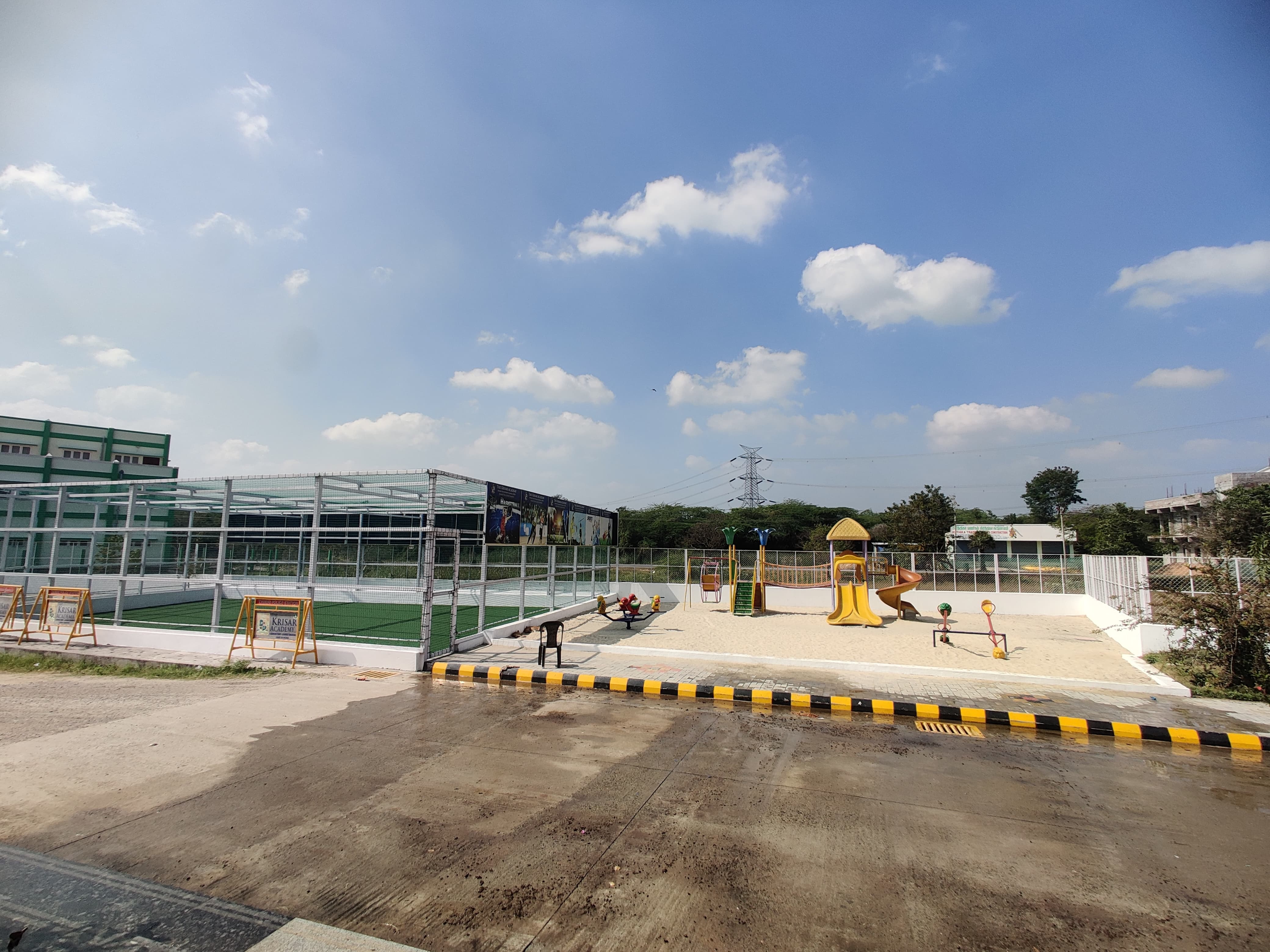
For families in this region looking for a full CBSE school from Pre-KG to Grade 12, The Krisar Academy is located on the Arcot to Arani Main Road, Paradarami Village, Ranipet District. The school offers integrated NEET and JEE coaching, smart classrooms, an AI and Robotics laboratory, and transport covering Arani, Arcot, Ranipet, Walajapet, and Vellore.
Admissions for 2025-26 are currently open.
Visit Our CampusContact: +91 75400 88387
View admission detailsFrequently Asked Questions
1. Is CBSE better than State Board in Tamil Nadu?
For students aiming at national competitive examinations like JEE and NEET, CBSE is the stronger foundation. The CBSE curriculum directly aligns with NCERT, which is the basis for both exams. State Board students typically need additional coaching to bridge this gap. For students focused on state-level careers or strong Tamil language education, State Board is a reasonable choice.
2. Can a State Board student crack JEE or NEET?
Yes, but it requires significant extra effort. State Board students entering JEE or NEET coaching need to first learn the NCERT framework, which CBSE students have already studied in school. Many students do crack these exams from State Board, but the preparation burden is higher and the time required is longer.
3. Is the CBSE grading system better than State Board?
CBSE uses continuous assessment throughout the year, reducing dependence on a single final examination. This generally gives a more accurate picture of a student's ability. State Board relies more heavily on final exam performance, which can disadvantage consistent students who struggle under single high-stakes sittings.
4. Which board is better for higher education in Tamil Nadu?
For admission to national institutions like IITs, NITs, AIIMS, and central universities, CBSE preparation is more directly relevant. For Tamil Nadu state universities and state engineering or medical colleges, both boards are accepted. However, competitive admission to state colleges also involves JEE and NEET, so the CBSE advantage applies there too.
5. Does CBSE include Tamil language?
Yes. CBSE schools in Tamil Nadu offer Tamil as a language subject. However, the depth of Tamil literature coverage is generally more extensive in State Board schools.
6. Which board has more schools in Tamil Nadu?
Tamil Nadu State Board schools significantly outnumber CBSE schools across the state, particularly in smaller towns and villages. CBSE schools are more concentrated in urban and semi-urban areas.